The ideas for these two excellent books with Lost in the title are marvelous and original -- not an easy accomplishment in an age of exponentially proliferating travel books!
Daniel Kalder's brashly funny Lost Cosmonaut explores some (there are lots) of the obscure republics of Soviet Europe: Tatarstan, Kalmykia, Mari El, and Udmurtia. The surface of Kalder's narrative is "disrespectful" and politically incorrect, which some readers might dislike, but I feel that one level deeper he actually conveys an existential empathy with his destinations that is, as he aptly puts it, "anti-touristic":
The anti-tourist does not visit places that are in any way desirable...The anti-tourist seeks locked doors and demolished buildings...The anti-tourist travels at the wrong time of year...The anti-tourist is interested only in hidden histories, in delightful obscurities, in bad art...The anti-tourist values disorientation over enlightenment.
And of disorientation, Kalder provides a-plenty.
Riccardo Orizio's Lost White Tribes is also thoroughly disorienting, taking on as it does the rich subject of colonial "left behinds," stragglers of history who never returned to their homelands. We get pockets of Dutch in Sri Lanka and Namibia, ex-Southern Confederates in Brazil (where slavery was legal until 1888, 23 years after the War between the States ended), French in Guadeloupe, Germans in Jamaica, and Poles in Haiti. These remnants are themselves disoriented, probably permanently. Some have become inbred; they are largely poor; most pine for a "golden" past they can never know; their relations with both their countries of residence and of origin are tenuous at best.
POSTSCRIPT: I first published this little note in 2008. Both books have remained robustly alive in my memory. Daniel Kalder's follow-up volume Strange Telescopes is also excellent.
Although I'm not that keen on how the Robert Zemeckis's career has gone since Who Framed Roger Rabbit, I still think his second feature as a writer-director, Used Cars, is one of the best and funniest of all American film comedies. The screenplay, which he co-wrote with Bob Gale, is an intricate contraption in which every seemingly stray line and visual bit pays off, and the execution is supremely high-spirited. Most fans' favorite scene, for good reason, is the last in a series of increasingly outrageous pirate car commercials. "Look out, Marshall Lucky, it's High Prices!"
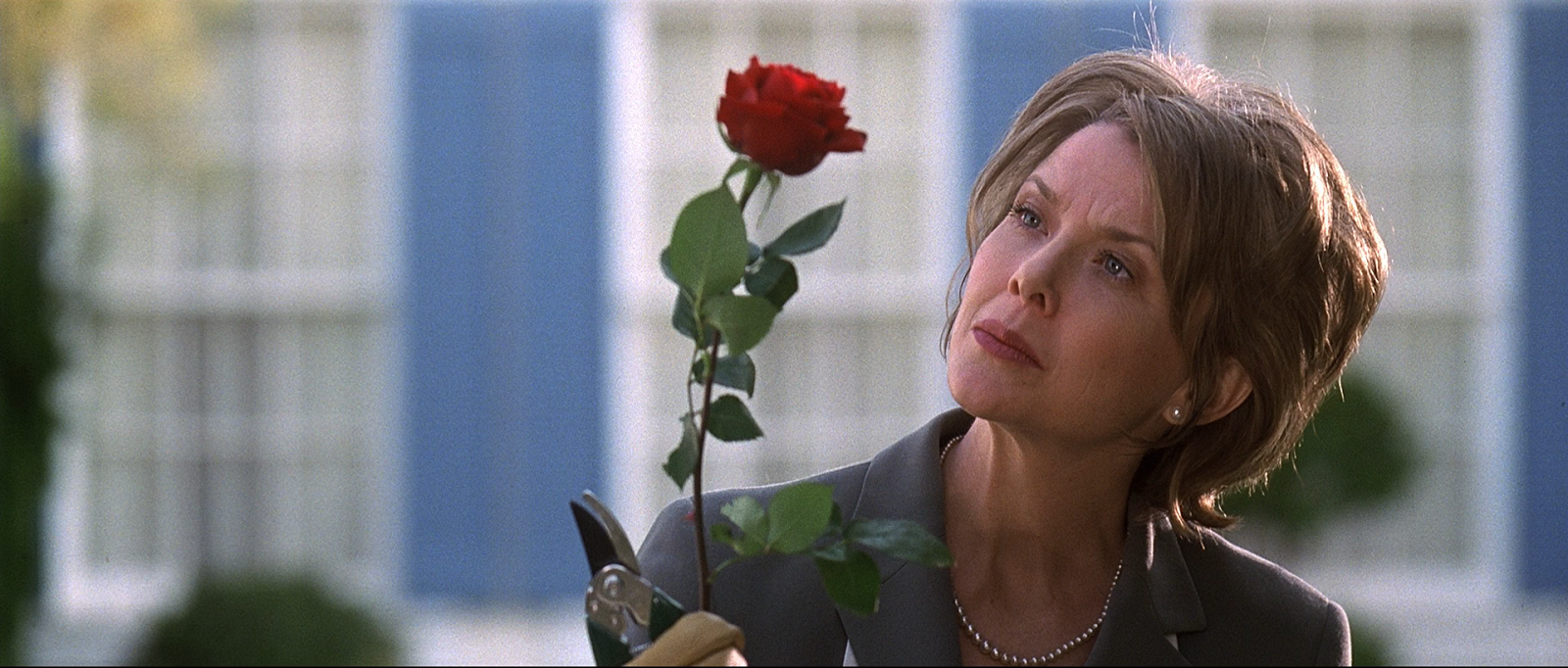
The title of Alan Ball's famous screenplay, American Beauty, refers, of course, to the roses that we see Annette Bening gardening in the opening scene (and that continue as a visual motif throughout the film). But there is considerably more to the reference than that; and I haven't seen this pointed out very often (it shows up in the film's Spanish Wikipedia entry, though). At the turn of the century, when the great journalist Ida Tarbell was investigating John D. Rockefeller and the Standard Oil Company, Rockefeller's son, John D. Rockefeller Jr., let loose a metaphor for which he was never forgiven in a speech at Brown University: “The American Beauty rose can be produced in its splendor and fragrance only by sacrificing the early buds which grow up around it.”
Of course, the theme of "success" is a large part of what American Beauty is about. It is scarcely a reach to see Kevin Spacey's Lester Burnham as one of the "early buds" sacrificed to the "splendor and fragrance" of capitalism; while Bening's Carolyn Burnham never surrenders her devotion to the ideal ("See the way the handle on her pruning shears matches her gardening clogs? That's not an accident"), and is further schooled in it by master Realtor Buddy Kane ("In order to be successful, one must project an image of success at all times"). The variations that Ball works on this theme are lush. Although American Beauty has never been the most popular film with the cinematic intelligentsia, I think it's a stunning piece of work. I've got to assume that Ball knew about the Rockefeller connection, because if not, the serendipity involved beggars belief.
Director John H. Auer, screenwriter Steve Fisher, and cinematographer John L. Russell (Hitchcock's DP on Psycho) make a good creative team on this underrated Hawaiian noir, which has many points of interest:
Gender -- The two key women in the film, Evelyn Keyes and Elsa Lanchester (playing one of her patented flakeroos), are exceptionally proactive and form an instant collaborative sisterhood. You only see that occasionally in movies of the era. A good comparison is the pairing of Grace Kelly and Thelma Ritter in Rear Window (which Wendell Corey made back-to-back with this film).
Race -- Hawaii has long been one of the most poly-racial places on earth, and that is reflected and indeed openly discussed in Hell's Half Acre (Keye Luke's police chief gently suggests that all Orientals might look alike to Keyes). We learn through the dialogue that Corey's girlfriend Nancy Gates is mixed-race; Korean-American actor Philip Ahn (below) is romantically paired with Marie Windsor; Eurasian actor Leonard Strong (so creepy as "The Hitch-Hiker" in the classic Twilight Zone episode) plays a key supporting role. There was a growing fascination in the Fifties with Eurasians and mixed white-Asian romances: think The King and I, Love Is a Many-Splendored Thing, The World of Suzy Wong, House of Bamboo. This sociological development was inevitable after World War II, the American occupation of Japan, and the Korean War, and it is strongly evidenced in Hell's Half Acre.
Wendell Corey -- Corey, with his ordinary guy looks, seldom got to play lead roles, and is effective here as "Chet Chester," a nightclub owner, racketeer, and part-time pop composer, precisely because of that ordinary quality. (By the way, I love the Chet Chester composition "Polynesian Rhapsody," one of those overblown spoken-word pop suites that were the rage at the time. It actually plays an important part in the plot.)
Location filming -- I am a sucker for location filming. Hell's Half Acre uses its Hawaiian locations well, and in that respect is a worthy precursor of the television series Hawaii Five-O. As with the series, it highlights the seamy rather than the picturesque side of Hawaii. The "hell's half acre" of the title is a Honolulu tenement district with "300 ways in, and 400 ways out," and the film-makers went right into the old A'ala neighborhood to shoot: You can tell that those rickety wooden structures are not sets.
Because there was no law against prostitution at that time, there were many houses of ill repute in the A'ala, Hotel Street and Chinatown areas. The sale of illegal black-market liquor to servicemen also flourished, with some of them also beaten and robbed in back alleys. The substandard living conditions that were particular to these areas of the city also were portrayed in the movie, with some of the scenes actually filmed on location in the A'ala Street area.
The end of the war also brought an unparalleled boom to the A'ala district as elsewhere, with the night life especially enjoyed by many. Huge crowds attended Japanese movies, several dance halls sprouted and other night businesses in the area flourished....in later years, the beloved A'ala district...[was] finally demolished for modern housing and development. Only fond memories remain today of what was once a busy and bustling area of the city.
Edginess -- Hell's Half Acre is pretty pulpy. Movies were starting to push up against the boundaries of the Hays Code at that time. This film features not just "miscegenation," specifically forbidden by the Code, but also the drugging and beating of women, and a quite nasty attempted rape. It's really a little scuzzy!
[SPOILER ALERT]
Denouement -- But perhaps the most unusual plot element in Hell's Half Acre is that Corey commits suicide at the end by setting up his own ambush. Granted that this might be considered his comeuppance for earlier criminal activity, and that his removing himself from the scene guarantees that his son will never know that his dad was a minor crime lord and not, as he thinks, a war hero; still, it caught my attention as an envelope-pusher. Are there other noir films in which a key character unmistakably commits suicide? I can think of Val Lewton's and Mark Robson's off-genre noir The Seventh Victim, with its double suicide ending (and I still don't know how they got away with that). What else?
POSTSCRIPT: After I first published this in an earlier blog in 2011, a correspondent at The Blackboard pointed out that Van Heflin stages his own death in Act of Violence. I should have thought of that one, and indeed, it is a very similar situation: the protagonist is not who he seems to be, his identity shift is related to what happened during World War II, and he comes to grief over it. (Don Draper's dual identity in Mad Men, also war-derived, has a pedigree in noir.)
Eric Burdon turns 74 today - I can't even process that. I love this picture of him, impossibly young, slightly surly and incredibly smart, with that challenging stare (and with book in hand!). In my high school teaching career, I've had students like this, and they are among my all-time favorites. If you can already see through the B.S. as a teenager, you're way ahead of the game. Many adults never get to that point.
Like so many British rockers of the Sixties, Eric Burdon attended art school, the Newcastle College of Art specifically, where he studied graphics and photography and formed his first band. More is waiting to be written about the rock music / art school connection, although Simon Frith and Howard Horne made a start on this with their short (and sadly out-of-print) 1988 volume Art into Pop. Camille Paglia has pointed out that attending art school exposed great future musicians to intellectual influences directly, instead of at two or three removes.
Here are some of the more famous art school attendees (and I'm leaving out many more obscure ones):
John Lennon (Liverpool College of Art)
Keith Richards (Sidcup Art College)
Pete Townshend (Ealing Art College)
Ronnie Wood (Ealing Art College)
Freddie Mercury (Ealing Art College)
Ian Dury (Walthamstow College of Art, Royal College of Art)
Syd Barrett (Cambridge Technical College Art Department)
Bryan Ferry (University of Newcastle upon Tyne Art Department)
David Bowie (Bromley School of Art)
Eric Clapton (Kingston College of Art)
Sandy Denny (Kingston College of Art)
Ray Davies (Hornsey College of Art)
Jeff Beck (Wimbledon College of Art)
Jimmy Page (Sutton Art College)
Brian Eno (Colchester Institute Art Department)
Simon Frith has written:
One of the most obvious sociological characteristics of British rock musicians, particularly of those who emerged in the classic 1960s period, is an art-school background.
James M. Curtis adds:
The art school in England is an institution designed to prepare kids to go into advertising and the like. But in the early sixties it was more than a mere vocational school; it was a lively place tolerant of nonconformity...It was at least in part because of his art school background that John Lennon was so receptive to Yoko's dada and minimalist ideas.
American rock musicians generally did not follow a similar path, and thus tended to be less intellectual and culturally aware than their British counterparts. Jim Morrison is an exception: he began his self-cultivation early, and actually took a class on Antonin Artaud at UCLA. Kurt Cobain had intellectual intuitions, and would have been a natural for art school in the right time and place - but he lacked sustained exposure to the world of ideas, which I believe would have greatly benefited him.
Here is Eric Burdon with one of the early line-ups of The Animals -- if you can keep track of who played in this band when, you're better than I am -- singing "We Gotta Get Out of This Place":
You have to hand it to ESPN's Chris Berman, who turns 60 today: not only does he have an entire category of phraseology named after him -- "Bermanisms" (Bert "Be Home" Blyleven, Mike "Nova" Scioscia, Jose "Can You See" Canseco) -- but he is also responsible for the now immortal pick-up line "You're with me, leather," which he does not deny using, but whose notoriety clearly annoys him. The master of catch-phrases, hoist by a catch-phrase he never intended for circulation! Something karmic about that.
"Separated at Birth" Department: Is it me, or are Berman and Mike Huckabee looking more alike by the minute? In the face and in the waist.
ESPN will still own intellectual properties like Grantland and the wildly popular podcast, the B.S. Report.
As big as Simmons was, and undoubtedly will be - let me put this in the manner of James Franco's fantastic character in Spring Breakers -
He didn't own his shee-it! He D-I-D-N-'T O-W-N his shee-it!
It really makes me think. Simmons, albeit somewhat full of himself, is very talented, and Grantland is a great website. But now Grantland isn't his anymore, and if he started a new, similar website that he does own, he would still be in competition with the sweat he expended in making Grantland what it is. That would have to hurt.
This is the new frontier for talent, especially because of the aggressive middlemen (Mark Zuckerberg, for example) in today's media climate: You've got to own your own material. I'll bet Simmons is KICKING himself now.
The opposite approach is well-evidenced by thriller writer J.A. Konrath, the King of Self-Publication, who is passionate on this subject. Konrath has benefited greatly by maintaining complete control over his creative output. He is not as rich as Stephen King (who is?), but he does damn well.
Like Konrath, Simmons started in a small-guy-self-promoting vein, with his BostonSportsGuy.com website back in the late Nineties. But it wasn't too long before he got swept up in Big Media, where he retained his persona but ultimately not his control, as last week's firing underlines.
Could Simmons have been big without ESPN? As big, probably not. But somewhat big, yes, certainly.
The thing is, though, that to a particular type of sports-and-pop-culture junkie like Simmons, the lure of the "big time" is irresistible. Catch this episode of The B.S. Report conducted at SXSW in Austin, with Jimmy Kimmel as the guest:
That is SO celebrity "inside baseball," calculated to make the viewer feel that he is hanging out with famous guys who hang out with other famous guys. It reminds me of Richard Schickel's acute perception in his book Intimate Strangers: The Culture of Celebrity, that one of the chief perks of fame is access to other famous people.
For Simmons, that access is like oxygen. Of course, he'll still have it. I'm sure he'll find his way, but getting embarrassed publicly by ESPN has to be counted as a major setback.
I don't mean to rip on the podcast, exactly. It's diverting, and Jimmy Kimmel is by far my favorite of the current crop of television late-night hosts.
But the podcast does model the world-view that Simmons and Kimmel and indeed ESPN share, which is well summed-up in the title of James Andrew Miller's and Tom Shales' history of ESPN: These Guys Have All the Fun.
This world-view isn't as loose and free as it looks. It is very strict, in fact, about which subjects are on the table and which are off. You can talk about Britney Spears and The Bachelor and even some talent agent that most in the audience have never heard of, as long as he vaguely brings Jeremy Piven in Entourage to mind. You don't talk about Thomas Piketty or Michael Tilson Thomas or who won the Pritzker Prize. That's not stuff that a "guy guy" thinks about.
This restrictiveness, and the sycophancy about fame (it can't be considered anything else), are pretty oppressive when you come right down to it, and that's why I have to have somewhat conflicted feelings about figures like Bill Simmons (or Kimmel or Jim Rome, whom I like better than Simmons).